Because I write about habit change and goals, my inbox is full of questions about the subject, ranging from “How can I be more assertive?” to “How do I lose weight?”
They’re looking for specific answers, and while I have a few (research “spotlight bias” and don’t eat after 6 pm), that’s not where I start. I want to know how the person who wants to be more assertive is sleeping at night, or what percentage of the day the person who wants to lose weight spends standing.
Big results, changes, or moves spring from small, consistent actions that support healthy bodily and psychological processes.
Without actively and purposely supporting healthy bodily and psychological processes, we’re setting ourselves up to fail at…everything else.

Desire Big, Ambitious Goals
Do you know what I want for you, and for me?
- Fulfilling personal relationships
- Rich interior lives
- Value-driven goals
- Metacognition
- Rewarding hobbies/interests
- A buoying spiritual practice
- Positive civic/community involvement
But we can’t have them. Not without fulfilling…less lofty conditions.
Cuz the things listed above are Level 3 (belongingness/love needs), 4 (esteem needs), and 5 (self-actualization) things. And we can’t get near those levels without filling in (to the best of our ability) the two previous ones.
Maslow’s Hierarchy of Needs
Yeah, I’m referring to Maslow’s Hierarchy of Needs (again). It’s a super useful tool.
Levels 3-5 are at the top of the pyramid, supported by the prior two levels (physiological and safety needs). The bottom levels aren’t exciting or flashy. They’re sturdy, and without them, everything (including the individual) falls apart.
We must, as consciously and consistently as possible, meet “lower level” requirements (adequate rest, nutrition, etc) to approach “higher level” goals (like the ones listed above).

Stop Orchestrating Failure
Listen: with habit change and goal making, it’s easier to focus on the “too-big” picture at first, fail, and throw our hands up, saying we weren’t built for it.
It’s also dramatic and fun (all that cortisol/adrenaline/dopamine, buying new gadgets and supplies)!
What’s not so easy or fun? Dialing down on small, daily habits that “fill in” our physiological and safety needs (levels 1 and 2), making the “rise” to levels 3-5 much less difficult.
So, how do we do that?
Track Small, Unassuming Habits
We can’t change or fix what we don’t know or see. Therefore, it’s time to see where and how we’re “stacking up” (get it, cuz it’s a pyramid) with habits.
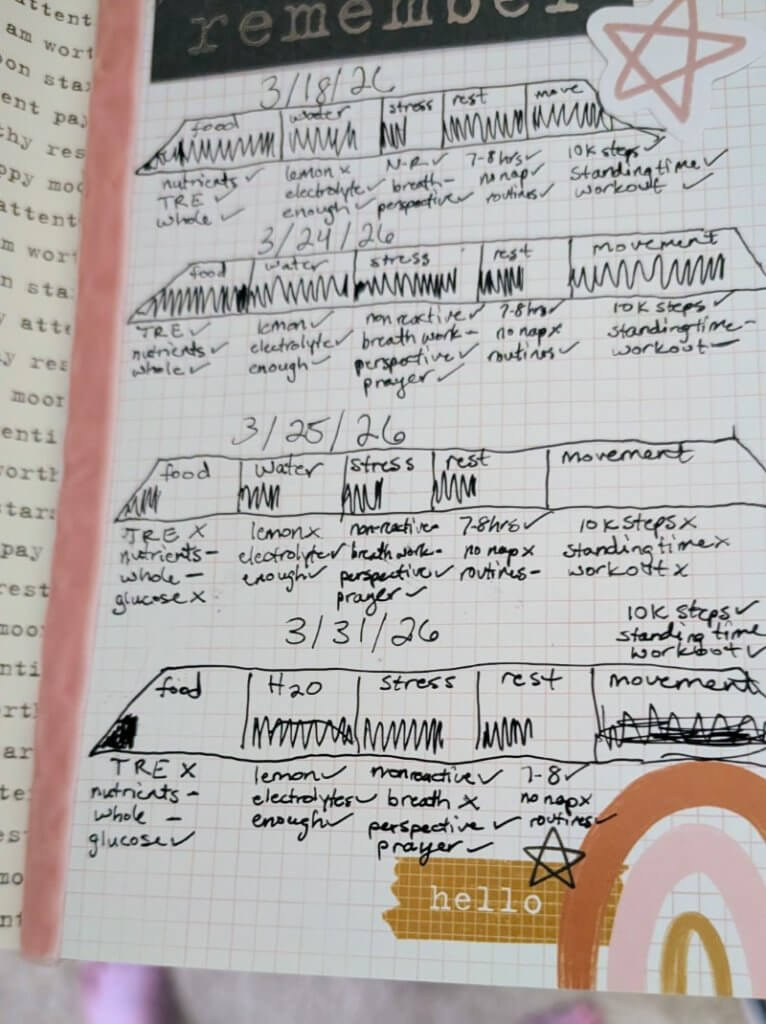
There are five categories in levels 1 and 2 of Maslow’s Hierarchy of Needs:
- Food
- Water
- Warmth (I changed that to stress)
- Rest
- Movement.
I give each category a grade. Either a check (completed), a dash (meh, kinda completed), or an X (not completed).
A Note On Subjectivity
You may not need eight hours of sleep, as seven is optimal for you. Or, perhaps your eating window is different from mine, due to work/medication schedules. Maybe spending time in prayer, for you, is hiking in the woods.
These kinds of things are flexible. There is room within the conditions for movement and exploration.
Changes made should be individual tweaks within the condition, not, like, removing (or adding) ones.
Getting adequate sleep, eating whole foods (in some kind of timed window), seeking perspective and nutrients (in the ways that work best for you) are non-negotiable.
What To Track AKA “Filling In The Level”
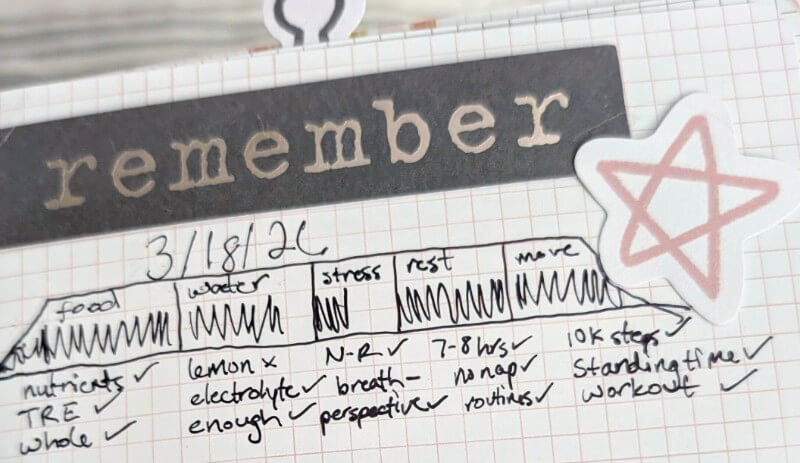
These are the stipulations (within the level one and two categories) that best support bodily and psychological processes.
Food conditions
- Time Restricted Eating (TRE): Did I follow the Perimenopausal timed eating recommendations from Pelz and that other lady whose name I can’t remember?
- Nutrients: Did I get enough fiber and protein (very subjective)? Supplements? Micronutrients?
- Whole: Did I avoid ultra-processed food?
- Glucose: Did I attempt to keep my glucose levels steady?
Water conditions
- Did I have lemon water? (While it won’t “alkalize” my cells or whatever, I do genuinely like the taste and find it a pleasant way to get more vitamin C)
- Did I have my electrolytes, fire cider, etc., concoction?
- Did I drink enough water (subjective)?
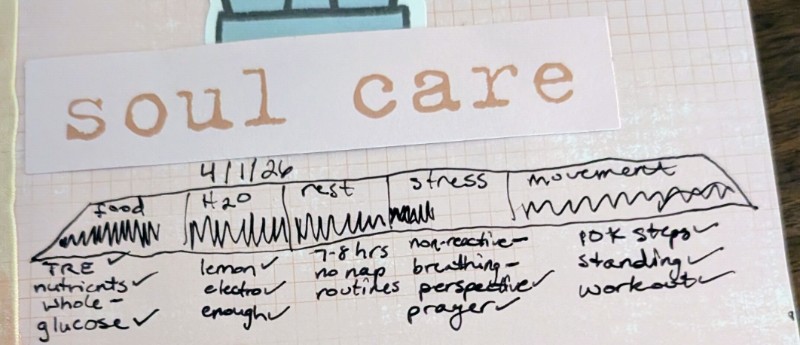
Stress conditions
- Was I Non-Reactive?
- Did I SEEK OUT perspective/reframing (cuz otherwise it ain’t coming)?
- Did I deep breathe when necessary, or at least notice and stop any shallow breathing?
- Did I spend time in prayer?
Rest conditions
- Did I get 7-8 hours of sleep the previous night?
- Did I nap during the day?
- Did I do my morning routine?
- Did I do my night routine?
Movement conditions
- Did I get 10K steps?
- How was my standing time?
- Did I do a (separate from walking) cardio or strength workout?
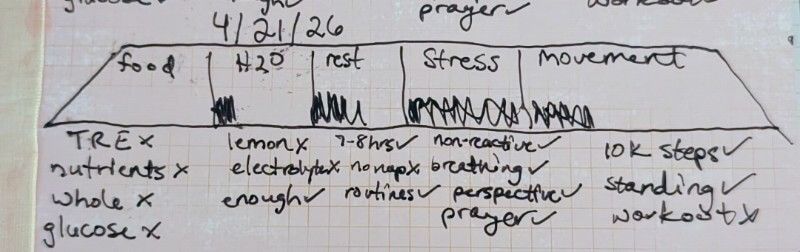
How To Track
There are a variety of ways you can track the completion of levels one and two:
- Journal it
- Use an electronic app
- Check off a list
- Aim to fill up a smallish container with pretty stones, each stone is a behavior/habit
But you have to track.
Maybe not forever. For a while, though.
The thing about filling in the first and second levels in order to achieve bigger and better goals is that we’re developing skills, not becoming new people. And developing new skills involves tracking, noticing effects/pratfalls, practicing, and refining behaviors. Not, just, you know…vibing.
(Sorry.)

You Have My Permission To Shop
These tracking devices can be truly helpful, especially in the beginning:
- ADHD Planner Reminder Keychain
- The Morning Sidekick Journal
- Habit Tracker Calendar
- Habit Tracker Hero Desk Pad

Low Down Habits Facebook Group
Need some extra help? I know I do. So I created a Facebook group
Join Low Down Habits with Ish Mom, where we document our ongoing efforts to shore up Maslow’s bottom levels, keeping an eye on the top ones, cheering each other on.
Conclusion
It’s gonna be our decade, man.
Dreams fulfilled, communication succinct, health optimal, all that. We just have to take care of a few smaller things first.

Want More?
Check out more articles in the “self-help” vein here:
Happy habit changing!
Love,